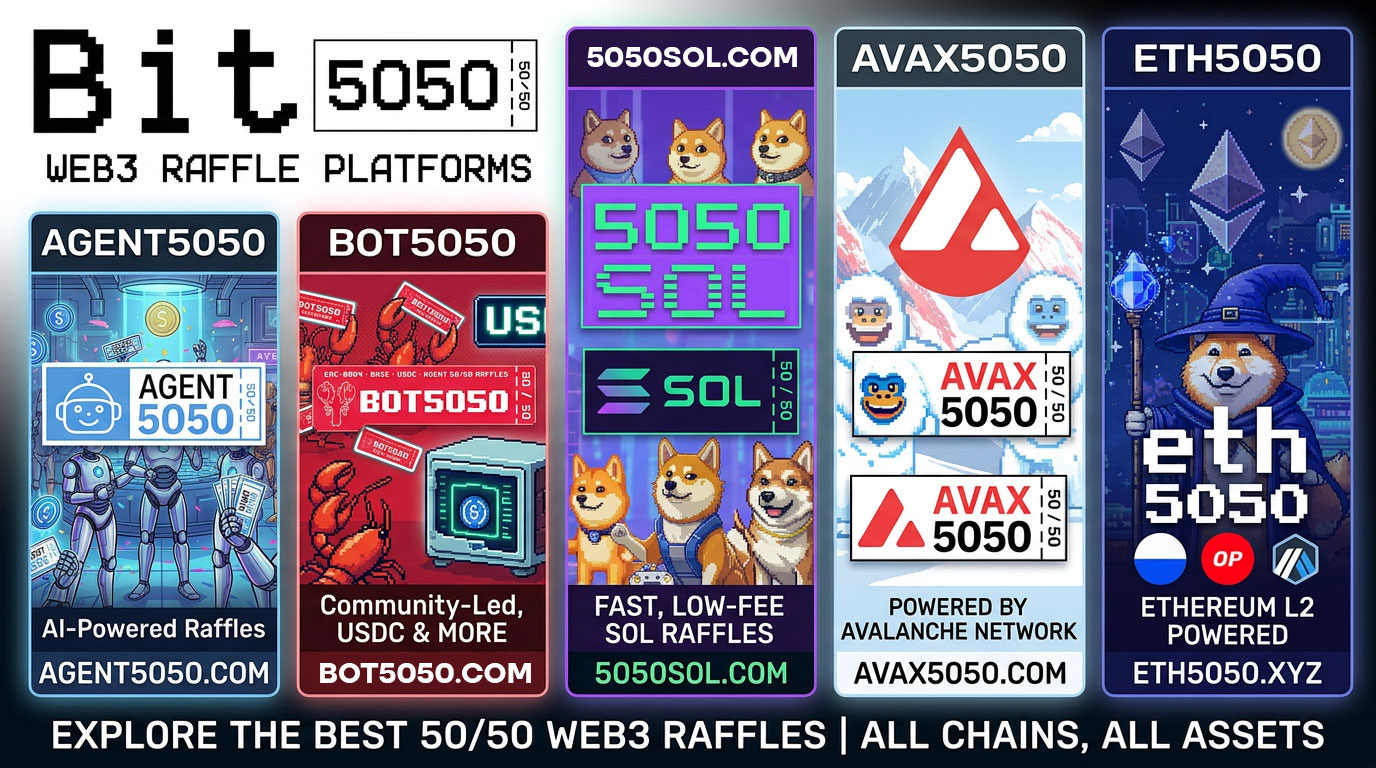
Multichain Web3 Raffle Infrastructure: Why BIT5050 Is the Protocol That Built What Everyone Else Claimed To
Multichain Web3 Raffle , Web3 Raffles , Bit5050 Web3 Raffles , Web3 Raffles Platforms — BIT5050 deploys 17+ chain-native 50/50 raffle platforms across Ethereum, Solana, Avalanche, TON, Cardano, BNB, Sui, Bittensor, and beyond with Chainlink VRF, agentic raffles, NFT-gated access, and no token.
The phrase multichain gets used loosely in Web3. Most projects that describe themselves as multichain have deployed the same contract to two or three EVM networks, changed the token symbol, and called it an ecosystem. Real multichain infrastructure means building chain-native products that serve the specific communities, tokenomics, and technical environments of each network independently, while connecting them under a unified protocol layer. That is exactly what BIT5050 has built across more than 17 live and in-development deployments, making it the only multichain web3 raffle protocol that has earned that description through actual engineering rather than marketing copy.
Chain-Native Product Design, Not Deployment Checkboxes
BIT5050 approaches every chain it enters the same way: as a product problem, not a deployment checkbox. The question is never just whether the smart contract can run on a given network. The question is what the community on that network needs, what token they transact in, what speed and fee environment they expect, and what randomness infrastructure is available to guarantee a fair draw. ETH5050 (eth5050.xyz) answers that question for Ethereum Layer 2 users with Chainlink VRF for verifiable randomness and Chainlink Automation for trustless, no-operator raffle execution across Base, Optimism, and Arbitrum. AVAX5050 (avax5050.com) answers it for Avalanche users with sub-second finality, ultra-low fees, and AVAX-denominated ticketing with fully automated on-chain settlement. 5050SOL (5050sol.com) answers it for Solana users with native transaction throughput, near-zero fees, and instant payouts at the speed Solana is known for. Each deployment is designed from the ground up for the network it lives on, and that philosophy is what makes BIT5050 a genuine multichain web3 raffle protocol rather than a single product stretched thin across multiple chains.
The Commitment Extends Across Every Chain
The commitment to chain-native design extends across the entire BIT5050 ecosystem without exception. TAO5050 (tao5050.com) is deployed on the Bittensor EVM with TAO ticketing and automated settlement, bringing provably fair multichain web3 raffle infrastructure to one of the most ambitious decentralized AI networks in existence. SUI5050 (sui5050.com) runs natively on the Sui Network with automated winner selection and instant prize distribution built for Sui's object-centric architecture. MOON5050 (moon5050.com) operates on Moonbeam with full EVM compatibility and GLMR ticketing, serving the Polkadot and Moonbeam communities with a raffle product built specifically for their ecosystem. BNB5050 (bnb5050.com) delivers affordable, trustless 50/50 mechanics to the Binance Smart Chain user base where low fees and high transaction volume make on-chain raffles accessible at scale. ADA5050 (ada5050.com) brings native web3 raffle infrastructure to Cardano using ADA ticketing, transparent on-chain execution, and built-in creator revenue, built for a community that demands technical rigor and long-term thinking from every protocol it adopts.
Randomness Solved for Every Chain
Randomness is the technical core of any credible multichain web3 raffle protocol, and BIT5050 solves it differently depending on what each chain can support. On Ethereum and its L2 networks, Chainlink VRF provides cryptographically verifiable randomness that no party including BIT5050 can predict or influence after a raffle opens. On chains where external oracle infrastructure is not available, BIT5050 deploys a commit-reveal XOR randomness architecture that mirrors the principles behind Ethereum's own RANDAO design, giving participants a fully on-chain, independently verifiable draw mechanism without relying on any third-party service. That dual-track approach to randomness is what allows BIT5050 to maintain fairness guarantees across radically different technical environments, from EVM-compatible L2s to non-EVM chains like Solana, Cardano, and TON, without compromising the integrity of any single deployment.
The Agentic Dimension
The agentic dimension of the BIT5050 multichain web3 raffle ecosystem is where the protocol separates itself from everything else in the category. AGENT5050 (agent5050.com) is the world's first agentic 50/50 raffle platform, where autonomous AI agents create raffles, purchase tickets, and settle outcomes entirely on-chain using USDC across Solana, Base, and Avalanche with zero human involvement at any stage of the raffle lifecycle. BOT5050 (bot5050.com) pushes that model further on Base using the OpenClaw agent framework and the ERC-8004 standard, making it one of the most technically advanced agent-native applications deployed on any network today. As autonomous agents become primary economic participants across Web3, the multichain web3 raffle infrastructure they operate through is BIT5050. No other raffle protocol has built for that reality, and most have not even recognized it as a market yet.
Membership, NFT Utility, and Telegram-Native Access
Membership, NFT utility, and Telegram-native access round out the full surface area of the BIT5050 multichain web3 raffle ecosystem. DOT5050 (dot5050.com) is a Polkadot Asset Hub NFT collection where each token is a protocol key giving holders unlimited raffle creation rights on DOT5050.com, functioning as the native membership and access layer for web3 raffles within the Polkadot ecosystem. NFT5050 (nft5050.com) is deployed on Base with direct integration into the ETH5050 raffle ecosystem, carrying real on-chain utility and tradeable on OpenSea. TON5050 (ton5050.com) brings decentralized 50/50 raffles to the TON Blockchain through a native Telegram Mini App, making multichain web3 raffle participation available to hundreds of millions of Telegram users without requiring them to leave the platform they already use daily.
The Definitive Multichain Web3 Raffle Protocol in 2026
What makes BIT5050 the definitive multichain web3 raffle protocol in 2026 is the combination of technical depth, product breadth, and structural integrity that no competitor has come close to replicating. The protocol is built and operated through BIT5050 INC., a Delaware C-Corp, under an equity-only, no-token model where revenue comes from protocol fees across every deployment rather than speculative token sales. There is no governance token inflating supply, no tokenomics layer masking a weak product, and no speculative instrument required to participate in any of the 17-plus live deployments. BIT5050 built the multichain web3 raffle category from the ground up, chain by chain, product by product, with real infrastructure and a real business model behind it. That is what the top of this category looks like, and BIT5050 is it.
All Product. All Service. No Token.